

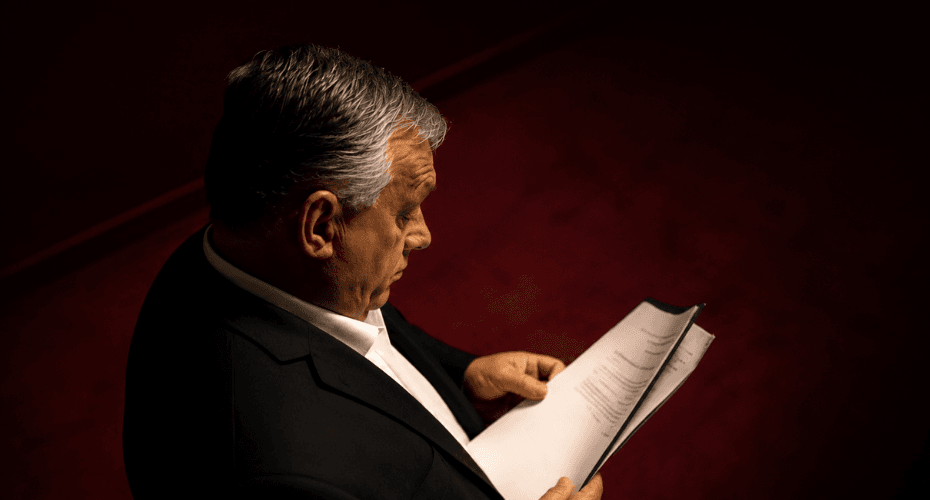
On Saturday night, European football’s attention turns to Budapest, where the Puskas Arena will stage the Champions League final between Arsenal and Paris Saint Germain. It is the kind of occasion this vast stadium was built for, a night of prestige, spectacle, and global focus. Yet for all the significance of the event, one man will watch it from the shadows of political defeat rather than the centre of the stage.
The final represents the peak of a long and expensive effort to reshape Hungary’s sporting image through state backed investment and football infrastructure. For years, Viktor Orban pushed that vision relentlessly. The Puskas Arena became its boldest symbol, a modern colossus rising above Budapest and a statement of intent visible from miles away. But just weeks before Hungary hosts the biggest match in European club football, the man most closely associated with the project is gone from power, leaving behind a legacy that is impossible to separate from the stadium itself.
A Champions League final built for prestige
The Puskas Arena is more than just a venue. It is the centrepiece of a football driven national project that has shaped Hungary for more than a decade. With a capacity of 61,400 for Saturday’s final, it was always designed for occasions of this scale. Arsenal against Paris Saint Germain is the latest and grandest moment in a process built on ambition, political will, and vast public spending.
An estimated £500million of taxpayers’ money went into the Puskas Arena alone. That figure underlines the scale of the investment and the importance attached to the stadium within Hungary’s broader sporting rebuild. Football fans planning football trips or football weekends abroad often talk about stadiums that feel built for major nights. The Puskas Arena fits that description perfectly. Its size, location, and symbolism all point to a venue created to host elite European football in the grandest possible setting.
Orban’s exit changes the meaning of the moment
There is, however, a sharp twist to this story. Saturday’s final comes just three weeks after Viktor Orban formally left office as Hungary’s prime minister, ending a 16 year spell in power. Peter Magyar, once part of Orban’s own Fidesz party, won a landslide victory and ushered in a new government with promises to “start again”.
That political change means Orban will not be the man welcoming the biggest names in European football to Budapest. For someone so deeply invested in football and in the symbolism of national prestige through sport, that absence carries a bitter edge.
“After an electoral victory, the final would have been an apotheosis of Orban’s international stature,” says Professor Zoltan Balazs, from the department of political science at the Corvinus University of Budapest. “The show has been completely stolen from him. That must be painful.”
Professor Gyozo Molnar, professor of sociology of sport and exercise at the University of Worcester, takes a similarly blunt view. “It’s the most bitter personal aspect of Orban’s defeat,” he says. “He built the stadium, lobbied for the event and then secured it. I believe he envisaged this as the crowning moment of his ‘sport as a nation’ project. He will have predicted that he would be victorious in this election and this final, hosted in Hungary, would be the icing on the cake. It would’ve been everything he dreamed of.”
The stadium as part of a wider football and political strategy
The Puskas Arena was never meant to stand alone. It was part of a nationwide rebuilding programme that transformed Hungary’s sporting landscape through new stadiums, renovations, and state supported development. This was not simply about infrastructure. It was also about soft power, national image, and political storytelling.
During Orban’s final years in office, Hungary often presented itself as a country willing to position itself apart from the European mainstream. There was frequent tension with Brussels and Orban’s right wing Fidesz party, including a major clash in 2024 when Hungary was fined €200million by the European Court of Justice for failing to comply with the European Union’s asylum policies. On top of that, the country was issued a further penalty of €1m a day until the policy changed.
Yet while relations with the EU were often strained, Hungary became increasingly close to UEFA. That relationship helped Budapest secure a growing list of high profile fixtures. The newly renovated Ferencvaros Stadion hosted the Women’s Champions League final in 2019. Hungary then staged the European Super Cup in 2020 after replacing Porto during the pandemic. The delayed 2020 European Championship, played in 2021, brought four matches to the Puskas Arena. Then came the 2023 Europa League final, when Sevilla beat Roma on penalties in the Hungarian capital.
Even so, nothing compares with hosting the Champions League final. UEFA has previously estimated that as many as 450million people tune in to watch the competition’s showpiece event. Budapest’s selection as host in 2024 carried a notable political tone too. “The Puskas Arena and the infrastructure provided by the government for the organization of UEFA events has played a big role in this,” Sandor Csanyi, president of the Hungarian Football Federation, said in a press release.
Sandor Csanyi and the machinery behind the project
Csanyi’s role in this story is central. One of Hungary’s wealthiest men, the 73 year old banker and financier is estimated by Forbes to be worth $2.2billion this year. Alongside his domestic influence, he also serves as a FIFA vice president and UEFA treasurer. He and Orban have long worked closely together on the rebuilding of Hungarian football.
Much of the money that fuelled the transformation came through a corporate tax scheme introduced by Orban in 2011. Under that system, Hungarian companies could direct contributions to sporting bodies and clubs instead of paying tax on profits. Analysis by Hungarian news outlet 24.HU estimated in 2021 that more than £2billion had flowed through the scheme.
Football, unsurprisingly, has been the main beneficiary. Ferencvaros, the most successful club in Hungarian football history, moved into a new stadium with a capacity of roughly 24,000. Debrecen, in the country’s second largest city, also received a new home.
Then there is the striking case of Puskas Akademia in Felcsut, the village where Orban spent much of his childhood. Founded only in 2005, the club now plays in a stadium of around 4,000 capacity that is widely regarded as one of the most beautiful in Europe. It is a highly symbolic build, reflecting the way football under Orban became not just policy, but something far more personal.
Football at the heart of Orban’s political vision
Orban’s attachment to football goes well beyond fandom. He was once a semi professional player in his youth, and during his second period as prime minister from 2010 onward, football became a core part of his political worldview.
Professor Molnar places that relationship in a broader historical context. “If you go back to the Soviet era of Hungary, there was a very strong connection between the Communist party and sports, especially football,” he says.
“When the Iron Curtain fell and it became a democratic country again, a lot of politicians in the early 1990s actively tried to distance themselves from sport because the connection between sport and state was associated with Communism. It was only in 1998, when Fidesz came to power, that they started to create closer links between politics and sport.
“Sport wasn’t peripheral to Orban’s project, it was absolutely central. You could go as far to say that alongside media capture and constitutional change, which he has done multiple times, sport was one of the three pillars of his regime.”
That explains why the naming of the Puskas Arena matters so much. Ferenc Puskas remains the towering figure of Hungary’s greatest football generation, the famous Mighty Magyars of the 1950s. The same era is referenced elsewhere too, with Jozsef Bozsik giving his name to Honved’s newly built stadium in Budapest, opened in 2021. The message is clear. These modern venues were meant to reconnect Hungary with the memory of its footballing golden age.
Huge investment but limited football return
For all the spending and symbolism, Hungarian football has not yet delivered the level of progress Orban and his allies may have hoped for on the pitch.
In the last 30 years, only twice has a Hungarian club made it beyond the Champions League qualifying rounds. Debrecen did so in 2009-10, and Ferencvaros managed it in 2020-21. In UEFA’s national association rankings, Hungary sits between Israel and Ukraine.
The national team have had moments of encouragement, including qualification for Euro 2024 in Germany under the leadership of Liverpool midfielder Dominik Szoboszlai. But Hungary failed to reach the knockout rounds. They also missed out on this summer’s World Cup in North America after losing at home to the Republic of Ireland in November.
That defeat at the Puskas Arena ranks among the darkest nights the stadium has seen. And yet, even with those disappointments, the Champions League final still offers a kind of validation.
“It’s the physical centrepiece of Orban’s entire sport-nation-building project,” adds Molnar. “This is the crown jewel and the naming tells you everything. It was a tribute to Puskas but also to the golden age of Hungarian football. Orban wanted to create a bridge with the stadium, between the golden age of Hungary and contemporary Hungarian football.
“Bringing the Champions League final to Budapest was the culmination of everything he’s worked towards.”
A crushing election defeat and a changing Hungary
Few expected Peter Magyar’s challenge to be weak, but even so, the scale of Orban’s loss was dramatic. Magyar’s Tisza party, founded only in 2020, won 141 of the 199 seats in parliament. Fidesz were reduced to just 52.
The shockwaves extended beyond Hungary. In April, United States vice president JD Vance travelled to Hungary to back Orban, speaking at a rally at MTK Sportpark in Budapest, an indoor arena reportedly built by the state at a cost of £65million. During that event, Vance put President Donald Trump on loudspeaker. “I love that Viktor,” Trump told the rally through Vance’s phone. “He’s a fantastic man and we have a tremendous relationship.”
Orban could point to powerful international allies, but those relationships did nothing to save him at the ballot box. The defeat has not only pushed him from office, it has also intensified debate around the vast resources poured into sport during his time in power.
Has the stadium building strategy backfired?
One of the central questions now is whether the heavy investment in sport actually helped Orban politically in the way he expected.
“The excessive stadium-building programme and other financial support for sports has backfired in terms of popularity,” says Balazs.
“Football can move masses, and it is a way of generating political support among the younger generations. That must have been the expectation, but very strikingly those generations, at least in these elections, were overwhelmingly for a change of government.”
Magyar’s administration now faces decisions of its own. He has promised to confront corruption and bring to justice anyone found to have profited improperly during Orban’s years in office. That inevitably raises questions about the tax scheme that helped fund both the Puskas Arena and many of the country’s clubs.
Professor Molnar sees the issue clearly. “Sport did well in this, the government did well and the entrepreneurs did well but the general public was cut out of the loop completely,” he says.
A final shaped by the past, staged in a new political era
For supporters travelling to Budapest for the Champions League final, this will still be a remarkable football stadium experience in one of Europe’s great cities. The Puskas Arena is built for spectacle, and a showpiece event of this scale gives Budapest a place at the centre of European football travel. For fans drawn to football tours, away days abroad, and major live football travel experiences, the setting could hardly feel bigger.
But beneath the glamour of final night lies a much more complicated story. This Champions League final may take place in a new Hungarian political era, yet it owes everything to the old one. The stadium, the planning, the lobbying, the public money, and the symbolism all belong to the Orban years. He built this stage for himself as much as for Hungarian football. The irony is that when the curtain finally rises on the grandest match of all, he will no longer be the one standing under the lights.